
After an initial muted response to the war with Iran, market volatility surged over the past week. Early beliefs in a limited and contained war faded after Iran’s retaliatory strikes began targeting Gulf refineries, desalination plants and shipping. In response, insurers pulled coverage citing war-risk provisions in policies. Unable to find insurance coverage, shippers pulled back and tanker traffic through the Strait of Hormuz plunged by 90%. This drove crude oil to move past the psychologically important $100 / bbl. threshold, stoking fears of stagflation. The S&P 500 has only experienced moderate levels of volatility from the war, with the intraday low today (March 9) of -1.5% surpassed by the -2.4% decline on March 3. Before the war, the market declined over 1% in a day on three occasions – the -2.1% return on January 20, which was largely driven by concerns over Greenland, and two days of declines of -1.6% and -1.0% in
February.
Among the major economies, oil-import dependent European and Asian economies stand to bear the most economic risk from this conflict. As of midday on March 9, equity market performance reflects this. Since the start of the conflict, European stocks returned -7.25%, Japan -6.7% and Korea -14%, compared to a 2% decline in the S&P 500. China and India held up better, each off about 3% since February 28. However, Europe, Japan and Korea remain positive and are the best performing markets year-to-date while the S&P 500 is down around 1%.
War-related oil price spikes tend to be short-lived. The First Gulf War and 2003 Invasion of Iraq caused only short-lived volatility. The 1979 Iranian revolution led to a more prolonged bout of inflation, however the US economy was much more dependent on foreign oil imports back then.
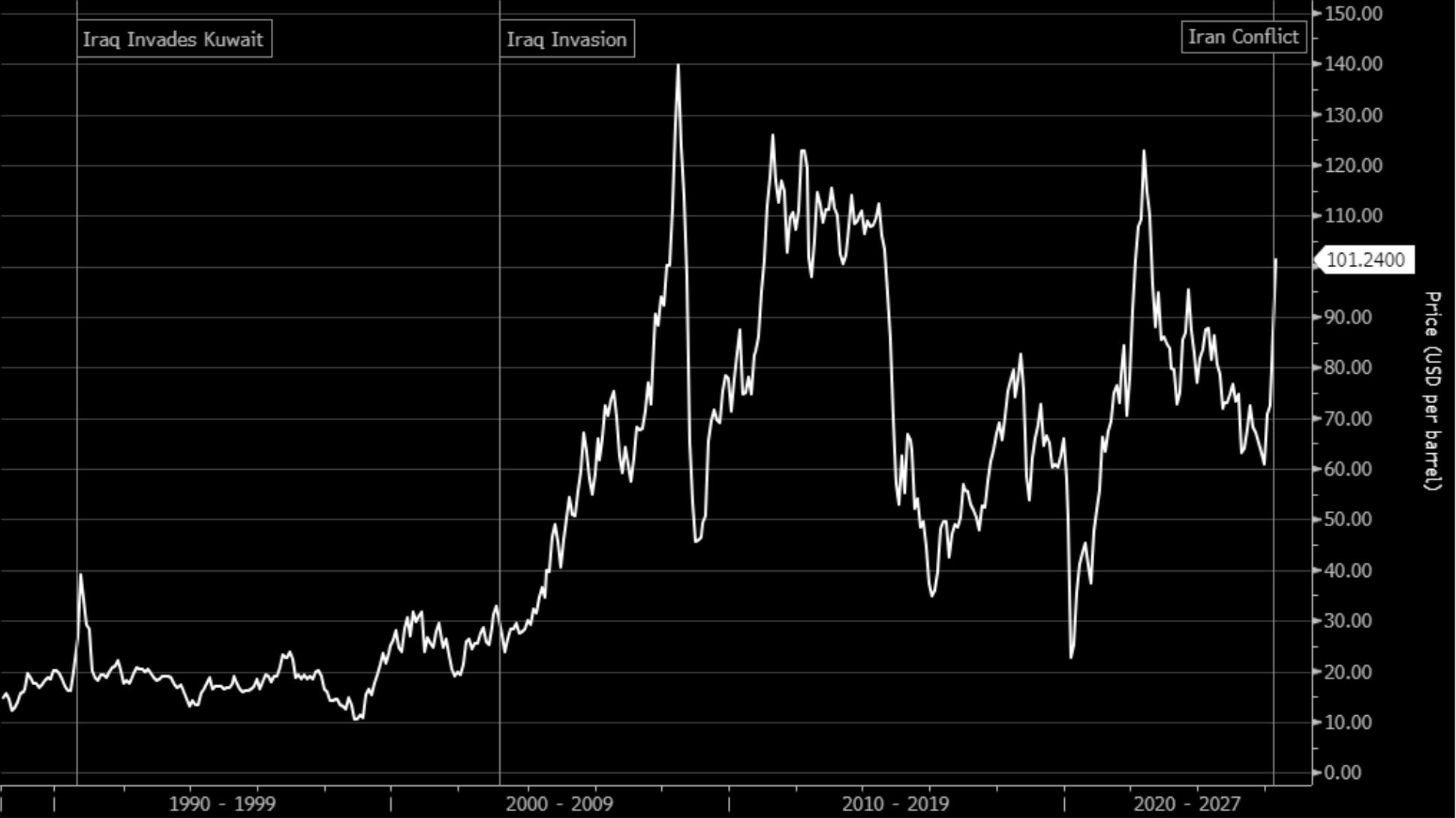
The situation remains fluid, with the Trump administration attempting to unblock the flow of oil by announcing a $20 billion reinsurance backstop for shipping in the Gulf. The administration has also spoken of naval convoys through the Gulf, but a specific program has not been announced yet. The issue for financial markets remains the flow of oil and liquified natural gas through the Gulf, rather than the conclusion of the war.
Potential catalysts for oil to fall back below $100 include:
- The continued degradation of Iran’s military capabilities
- US insurance backstop and potential naval convoy support
- An OPEC+ production increase
- a modest increase was announced March 1, but a bigger increase could follow
- Limited capacity for exports outside the Strait of Hormuz from the Gulf States and from Russia make this less effective
- A dovish pivot from the Fed on the upcoming March 17 meeting
- Release of the Strategic Petroleum Reserve
Financial markets react to perceived economic risks and remain aloof from much of geopolitics, as evidenced by the recent bull market against the backdrop of the Ukraine war, US tensions with China and the Israeli conflict with Hamas. The volatility this week appears to be specifically focused on the flow of oil, rather than the conflict in general. As outlined above, a number of levers can be pulled to ease this stress aside from a full conclusion of the war.
Despite the volatility, the absolute level of market decline remains muted, making it difficult to view this as a great buying opportunity. Nevertheless, deploying cash appears more attractive today than last month. We generally advise refraining from rebalancing between different parts of the equity markets, as these levels of volatility can make holding transactional cash risky. Being out of the market overnight with a mutual fund trade, or intraday for a stock or ETF trade poses risks of being on the wrong side a move of a percentage point or more.