
Markets initially rallied after the Democrats’ success in Tuesday’s election, but Thursday brought the worst one-day decline for the NASDAQ 100 since the COVID-related crash in March 2020. Wednesday’s rally could be interpreted as relief that election uncertainty had been removed and as support for the adage that markets like divided government. Thursday’s selloff, by contrast, centered on opposition to new data centers, which emerged as a key election theme: all but one of the more than 45 state ballot initiatives restricting data centers passed, and newly elected Democratic governors in key states (Texas, Georgia, Ohio and Iowa) ran on moratoriums. The companies most exposed to data center growth fell hardest. Hyperscalers like Alphabet and Meta actually outperformed the S&P 500, while semiconductors and a basket of data center construction stocks, which include companies that either develop data centers or provide services like electrical, HVAC or power generation, were the worst performers:
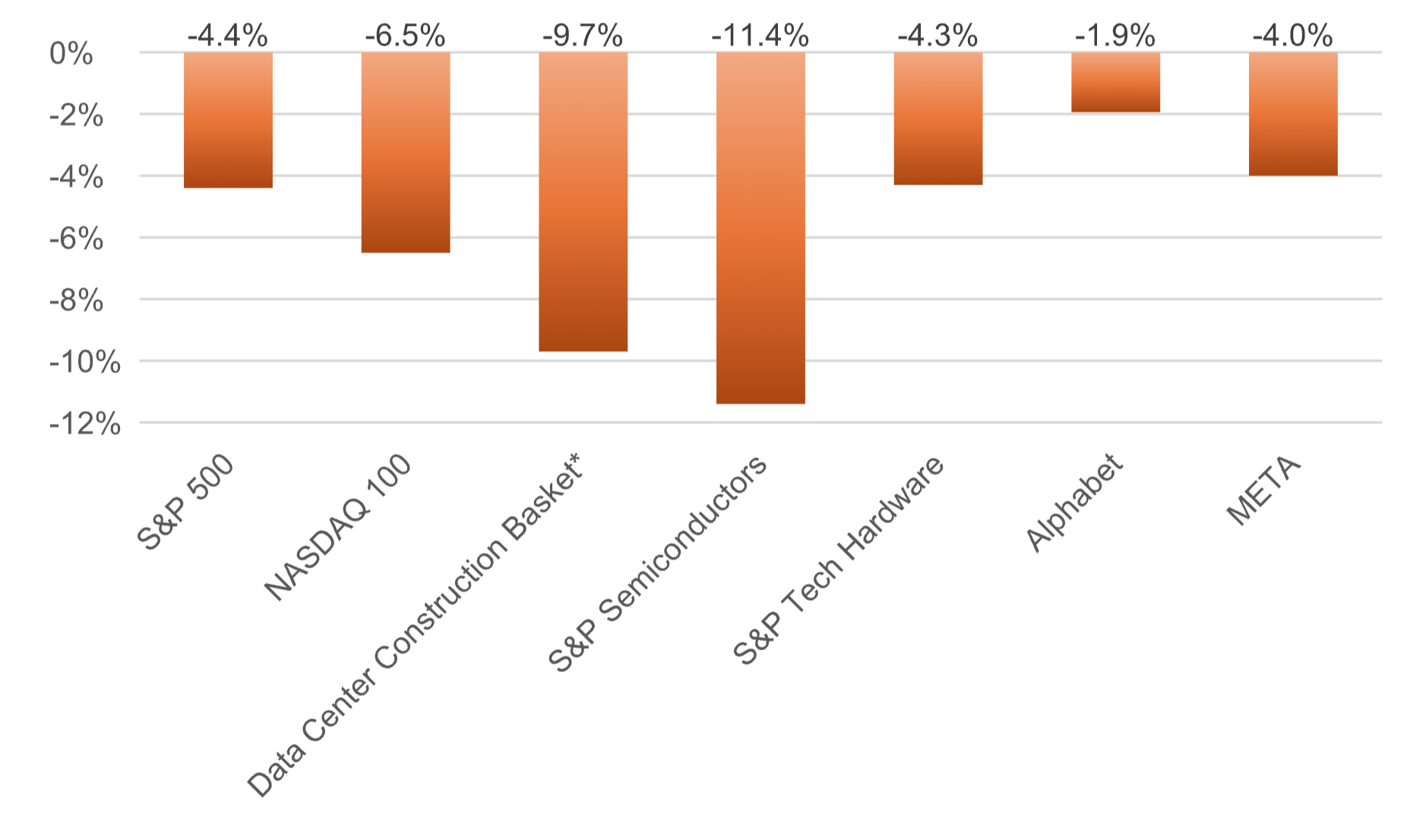
*Basket consists of industrials with growth expectations tied to data center construction:
Vertiv, IES, Primoris, Quanta, Comfort Systems, Ge Vernova, EMCOR, MYR, Limbach Holdings and MasTec
The opposition to data centers stems from number of concerns related to strain on electric grids, quality-of-life disruption, minimal long-term employment and concerns about water usage. While most of these concerns can be mitigated, we expect data center construction to slow. However it will be several years before the impact of potential new restrictions is felt. There are currently around 400 projects representing 70GW currently under construction which represents more than a doubling of the current US capacity of 49GW. Furthermore, over 1,000 projects totaling 276GW are past basic approvals.
Investors valued parts of the AI infrastructure ecosystem on the assumption of an exceptionally rapid buildout. With aggressive expectations, even modest delays can produce substantial stock volatility. A project pushed out twelve or eighteen months reduces the present value of future earnings even if the project ultimately gets built.
Companies with speculative business plans, heavy financing requirements or distant expected cash flows remain particularly vulnerable to delays. Established companies with strong balance sheets, existing infrastructure and profitable core businesses should have far greater ability to absorb a slower development schedule.
This distinction resembles a theme we have emphasized throughout the AI boom. A transformative technology does not guarantee attractive investment returns for every company associated with it. The internet transformed the economy despite destroying enormous amounts of investor capital during its infrastructure buildout. Artificial intelligence can follow a similar pattern in which the technology succeeds spectacularly while individual investments generate dramatically different results.
We therefore expect the AI buildout to continue, but along a bumpier and potentially slower path. Political resistance will delay some projects, redirect others toward more receptive locations and increase the value of existing power and infrastructure. For investors, this argues for greater attention to balance sheets, permitting risk, access to electricity and the distinction between companies earning profits today and companies whose valuations depend on projects years in the future.